Japan is one of the safest countries in the world, but it is also one of the most earthquake-prone. 🌸
For many visitors, experiencing even a small earthquake can feel frightening simply because it is unfamiliar.
The reassuring news is that Japan has one of the world’s most advanced earthquake monitoring systems, strict building standards, and well-prepared emergency procedures. 🏯
Knowing a few simple safety steps before travelling can help you stay calm and enjoy your journey with confidence.

- Stay Calm—Most Earthquakes End Quickly 🧘
- If You Are Inside a Building 🏨
- If You Are Outside 🚶
- If You Are on a Train 🚆
- If You Are Staying at a Hotel 🛏️
- Emergency Alerts on Your Phone 📱
- After the Earthquake 🌅
- Emergency Numbers in Japan ☎️
- Helpful Japanese Phrases 🗣️
- Arrival Day Tip ✈️
- Frequently Asked Questions
- Final Thoughts ❤️
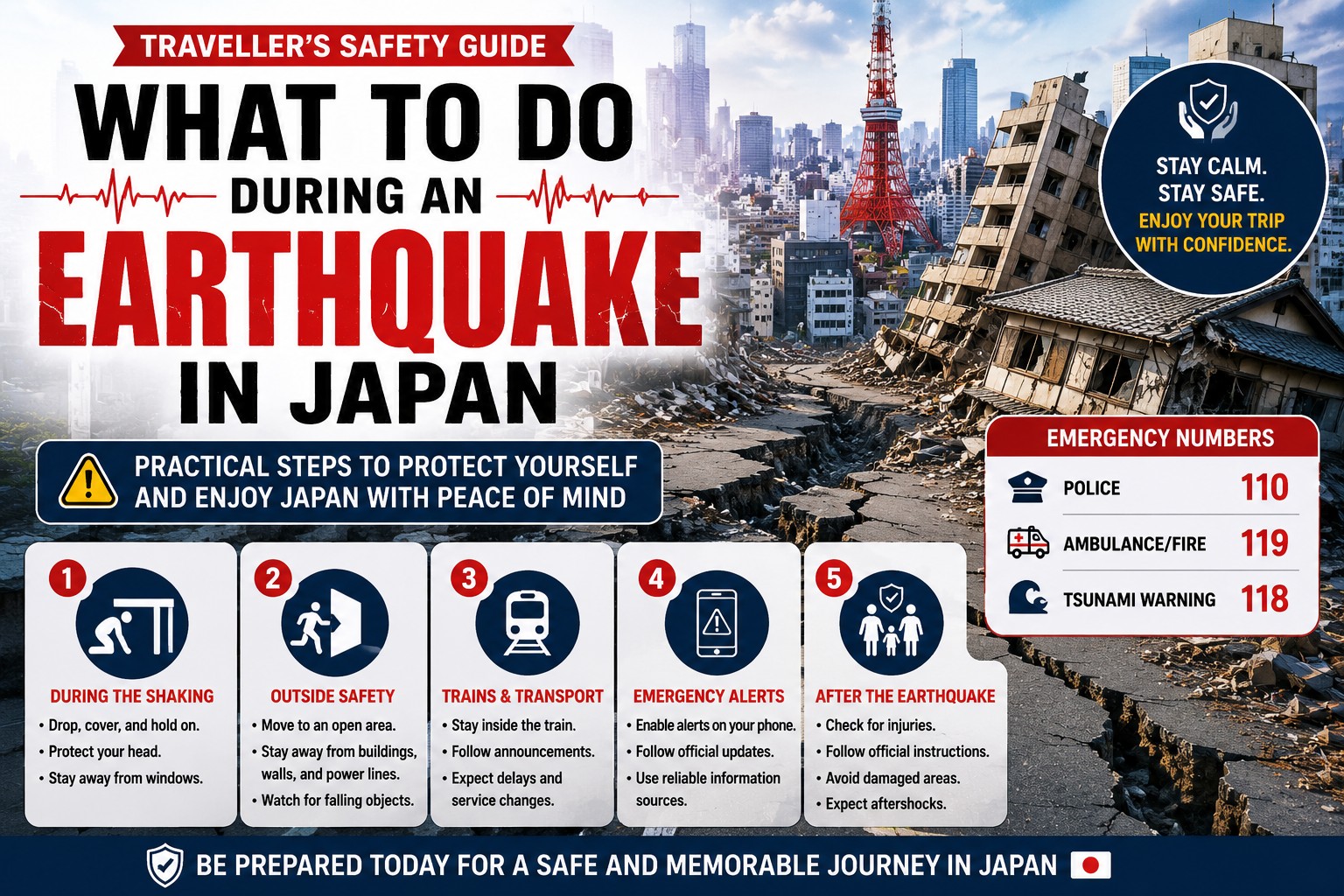
Stay Calm—Most Earthquakes End Quickly 🧘
The first and most important rule is simple:
Don’t panic.
Many earthquakes last less than one minute.
Modern hotels, shopping centres, airports, and railway stations are designed to withstand significant shaking.
If everyone around you remains calm, follow their example and listen carefully to announcements.
If You Are Inside a Building 🏨
When the shaking begins:
- Stay indoors.
- Protect your head with your hands, a bag, or a cushion.
- Move away from windows and glass.
- Do not use lifts.
- Wait until the shaking completely stops before moving.
Many hotels provide emergency information in English, and staff are trained to assist international guests.
If You Are Outside 🚶
Being outdoors requires different precautions.
Try to:
- Move away from buildings.
- Avoid glass windows and signs.
- Stay clear of utility poles and overhead wires.
- If possible, head toward an open space such as a park.
Avoid running into traffic.
If You Are on a Train 🚆
Japan’s railway network automatically detects earthquakes.
When a significant earthquake occurs:
- High-speed trains slow down or stop automatically.
- Station staff provide instructions.
- Stay inside the train unless directed otherwise.
- Follow announcements calmly.
Train delays after earthquakes are normal and are carried out for passenger safety.
If You Are Staying at a Hotel 🛏️
Luxury hotels and major international hotels have detailed emergency procedures.
Upon arrival, it is helpful to:
- Locate emergency exits.
- Check the evacuation map behind your room door.
- Keep your passport close by.
- Save the hotel’s address on your phone.
Choosing accommodation with multilingual staff can provide additional peace of mind.
Emergency Alerts on Your Phone 📱
Most smartphones connected to Japanese mobile networks automatically receive earthquake warnings.
These alerts often sound before strong shaking begins.
Do not ignore the alarm—it gives valuable seconds to prepare.
Useful travel apps can also provide:
- Weather alerts
- Earthquake information
- Transport updates
- Evacuation guidance
After the Earthquake 🌅
Once the shaking stops:
- Check yourself and others for injuries.
- Follow instructions from local authorities.
- Expect transport delays.
- Avoid entering damaged buildings.
- Stay informed through reliable news sources.
Most tourist areas return to normal quickly after minor earthquakes.
Emergency Numbers in Japan ☎️
| Service | Number |
|---|---|
| Police | 110 |
| Ambulance | 119 |
| Fire | 119 |
If language is a concern, many operators can arrange interpretation support depending on the situation.
Helpful Japanese Phrases 🗣️
| English | Japanese |
|---|---|
| Are you okay? | Daijōbu desu ka? |
| Help! | Tasukete! |
| Where is the evacuation area? | Hinan basho wa doko desu ka? |
| I need an ambulance. | Kyūkyūsha onegaishimasu. |
Arrival Day Tip ✈️
After a long international flight, many travellers appreciate keeping their first day relaxed.
A private airport transfer, early check-in (when available), or a visit to an onsen or spa can make it easier to recover from travel fatigue while helping you stay refreshed and aware of your surroundings.
Frequently Asked Questions
Is Japan safe despite earthquakes? ✅
Yes. Japan has world-leading earthquake-resistant construction, comprehensive disaster education, and highly organised emergency response systems.
Should I cancel my trip because Japan has earthquakes? 🤔
For most travellers, no. Small earthquakes are relatively common, but serious events are much less frequent. Staying informed and following local guidance is usually the best approach.
Will hotels help international guests?
Most major hotels and international brands have emergency procedures and staff trained to assist overseas visitors.
Final Thoughts ❤️
An earthquake can feel unsettling, especially during a first visit to Japan. However, understanding a few basic safety steps can make a remarkable difference.
With preparation, awareness, and confidence, you can focus on what truly makes Japan unforgettable—its warm hospitality, breathtaking landscapes, rich traditions, and extraordinary travel experiences.
Safe travels, and enjoy every moment of your journey.

コメント