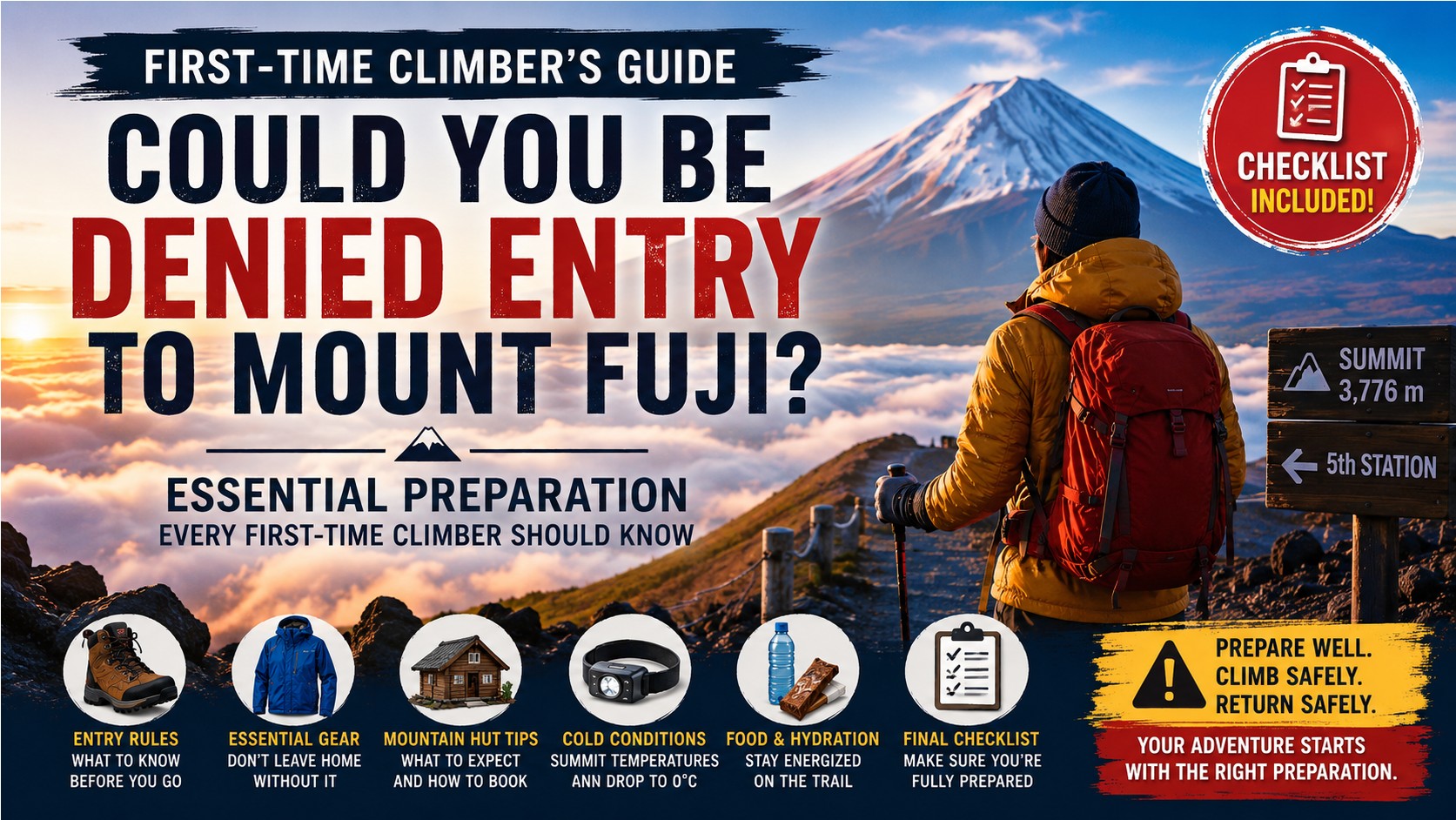
- Mount Fuji Is More Than Just a Tourist Attraction
- Always Check the Official Mount Fuji Website Before Your Trip
- Can You Really Be Denied Entry?
- Which Trail Is Best for First-Time Climbers?
- These Items May Determine Whether You Are Allowed to Start Your Climb
- These Essential Items May Determine Whether You Are Allowed to Start Your Climb
- Have You Packed Everything?
- Why a Mountain Hut Is More Than Just a Place to Sleep
- Avoid “Bullet Climbing”
- Final Preparation Checklist Before Your Climb
- Frequently Asked Questions
- Check the Official Website One Last Time Before Departure
- Conclusion
Mount Fuji Is More Than Just a Tourist Attraction
Standing at 3,776 metres, Mount Fuji is one of the world’s most recognisable mountains and an unforgettable destination for many travellers.
Watching the sunrise above the clouds, reaching the summit, and experiencing Japan’s highest peak are memories that last a lifetime.
However, many first-time climbers underestimate what climbing Mount Fuji actually involves.
Because it is so famous, some visitors assume it is similar to walking to a scenic viewpoint or visiting a popular tourist attraction.
It is not.
Mount Fuji is a high-altitude mountain, where weather conditions can change rapidly, temperatures can fall dramatically, and proper preparation is essential for your safety.
In recent years, additional climbing regulations have also been introduced to improve safety, reduce overcrowding, and protect the mountain’s natural environment.
As a result, some climbers may not be allowed to start their climb if they arrive without completing the required procedures or without suitable equipment.
Fortunately, these situations are easy to avoid with careful planning.
This guide explains everything first-time climbers should prepare before travelling to Mount Fuji so that they can begin their adventure with confidence.
Detailed information about entry procedures, online registration, entry fees and seasonal regulations will be covered in a separate guide.
Always Check the Official Mount Fuji Website Before Your Trip
Mount Fuji’s climbing rules are reviewed whenever necessary to improve safety and protect the mountain.
For that reason, this article should be used as a preparation guide only.
Before travelling to Mount Fuji, always check the official website for the latest information.
The following information may change from season to season:
- Opening and closing dates
- Entry fees
- Online registration requirements
- Entry gate operating hours
- Trail conditions
- Mountain hut availability
- Required climbing equipment
- Temporary trail closures
- Weather warnings and volcanic information
Official Mount Fuji Website

The official website also explains that climbing Mount Fuji requires careful preparation because it is a mountain exceeding 3,000 metres, not simply a sightseeing destination.
Important
Never rely solely on blog posts, social media or old travel guides.
Before beginning your climb, always confirm the latest information on the official Mount Fuji website. Entry rules, climbing periods, required equipment and trail conditions may change.
It is also highly recommended to check the official website again the day before and again on the morning of your climb.
Can You Really Be Denied Entry?
Yes.
Many people are surprised to discover that climbing Mount Fuji is no longer as simple as arriving at the trailhead and starting to walk.
To improve safety and reduce congestion, several management measures are now in place.
Depending on the trail and the current conditions, you may not be allowed to begin your climb if:
- You arrive outside the official climbing season.
- Required entry procedures have not been completed.
- The required entry fee has not been paid.
- You arrive during restricted entry hours.
- A mountain hut reservation is required but you do not have one.
- Your equipment is considered clearly inadequate for safe climbing.
- The trail is temporarily closed.
- Weather or safety conditions require access restrictions.
- You ignore instructions given by mountain staff.
One of the most common problems for inexperienced climbers is insufficient equipment.
Arriving with ordinary trainers instead of hiking boots, bringing only a lightweight rain poncho, or carrying no warm clothing can create serious safety risks.
This does not mean that every missing item automatically results in being refused entry.
However, if mountain staff determine that your equipment is clearly inadequate for safe climbing, you may not be allowed to continue.
Preparing properly before travelling is the easiest way to avoid disappointment.
Which Trail Is Best for First-Time Climbers?
Mount Fuji has four official climbing trails, each offering a different experience.
Choosing the right trail is one of the most important decisions you will make before your trip.
| Trail | Main Features | Beginner Recommendation |
|---|---|---|
| Yoshida Trail | The most popular trail with many mountain huts, rest areas and support facilities. | ★★★★★ |
| Fujinomiya Trail | The shortest route to the summit but with steeper sections. | ★★★★☆ |
| Subashiri Trail | A quieter trail that begins through beautiful forest before joining higher alpine terrain. | ★★★☆☆ |
| Gotemba Trail | The longest route with fewer mountain huts and a greater physical challenge. | ★★☆☆☆ |
You can compare all four official routes, mountain huts and estimated climbing times on the official Mount Fuji website.

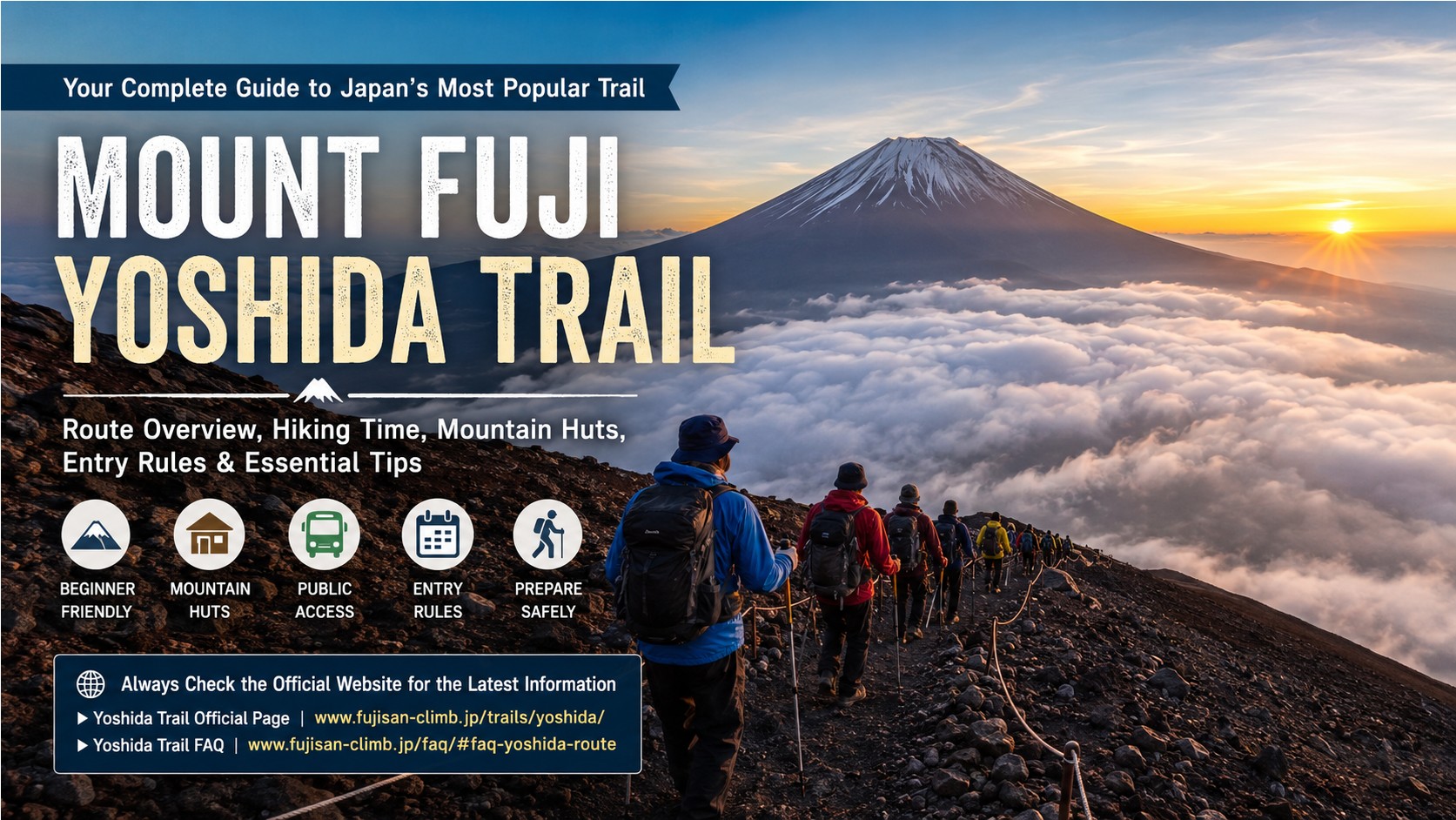
Yoshida Trail Is Usually the Best Choice for Beginners
For most first-time climbers, the Yoshida Trail is the recommended option.
Compared with the other routes, it offers:
- More mountain huts
- More rest stations
- Better access to emergency support
- Clear trail markings
- A larger number of other climbers if assistance is needed
However, popularity also means larger crowds.
During weekends and peak climbing periods, allow extra time and book mountain huts well in advance.
The Shortest Route Is Not Always the Easiest
Many people assume that a shorter climbing distance automatically means an easier hike.
That is not necessarily true.
Although the Fujinomiya Trail is the shortest route to the summit, it includes steeper sections that may feel more demanding for inexperienced climbers.
The Gotemba Trail, meanwhile, is significantly longer and is generally better suited to experienced hikers with strong endurance.
Instead of choosing a trail based only on distance, compare:
- Total climbing time
- Elevation gain
- Mountain hut locations
- Available facilities
- Your own hiking experience
before making your decision.
These Items May Determine Whether You Are Allowed to Start Your Climb
Before travelling to Mount Fuji, make sure your equipment is fully prepared.
According to the official Mount Fuji guidance, hikers should carry suitable hiking boots, separate waterproof rainwear, warm clothing, a headlamp, a backpack, drinking water and energy food.
In addition to helping you climb safely, having the correct equipment may also prevent problems before you even reach the trail.
The essential equipment checklist begins in the next section.
These Essential Items May Determine Whether You Are Allowed to Start Your Climb
Before travelling to Mount Fuji, make sure you have every essential item packed.
According to the official Mount Fuji guidance, hikers should prepare suitable hiking boots, separate waterproof rainwear, warm clothing, a headlamp, a backpack, drinking water, energy food and other basic climbing equipment.
Arriving with clearly inadequate equipment may result in mountain staff determining that it is unsafe for you to continue.
Take a few minutes to check every item before you leave.
Hiking Boots
Proper hiking boots are one of the most important pieces of equipment for climbing Mount Fuji. 🥾
The trails include volcanic rocks, loose gravel, uneven steps and steep slopes.
Ordinary trainers or sandals do not provide enough grip or ankle support, increasing the risk of slipping or injury.
Choose hiking boots that offer:
- Good ankle support
- Durable, slip-resistant soles
- Waterproof protection
- A comfortable fit
- Soles in good condition
If you have bought new boots, wear them several times before your trip to reduce the chance of blisters.
Separate Waterproof Rainwear
Weather conditions on Mount Fuji can change very quickly. 🌧️
Even if the forecast looks clear, rain, fog and strong winds can develop within a short period.
A lightweight rain poncho may be suitable for sightseeing, but it is not recommended for mountain climbing because strong winds can lift it easily and leave your legs exposed.
Prepare a proper two-piece waterproof set consisting of:
- Waterproof jacket
- Waterproof trousers
Besides protecting you from rain, your rainwear also acts as an important windproof outer layer.
Warm Clothing for Near-Freezing Conditions
Many first-time climbers are surprised by how cold Mount Fuji can become.
Even during the summer climbing season, temperatures near the summit are often around 0–5°C.
Before sunrise, temperatures may fall below 0°C, and strong winds can make it feel even colder. 🧥
Imagine standing outdoors on a cold winter morning for an extended period—that is much closer to the conditions you may experience at the summit than a typical summer day.
Dress in layers so that you can adjust your clothing throughout the climb.
A recommended layering system includes:
- Moisture-wicking base layer
- Long-sleeved mid layer
- Fleece jacket
- Lightweight down jacket
- Waterproof outer shell
- Gloves
- Warm hat or beanie
- Neck warmer
Avoid cotton clothing, as it absorbs moisture and dries slowly, making it much easier to become cold.
Headlamp and Spare Batteries
If there is any possibility of walking before sunrise or after sunset, a headlamp is essential. 🔦
Using a mobile phone flashlight is not recommended because:
- It provides limited visibility.
- Cold temperatures drain phone batteries quickly.
- You need both hands free while climbing.
- A dropped phone may be difficult to recover on rocky terrain.
Always test your headlamp before leaving home and carry spare batteries or a fully charged backup light.
Drinking Water and High-Energy Food
Climbing Mount Fuji requires many hours of continuous physical effort.
Bring enough water and energy-rich food to keep your body fuelled throughout the climb. 💧
Suitable choices include:
- Water
- Sports drinks
- Energy bars
- Chocolate
- Nuts
- Energy jelly
- Dried fruit
- Hard sweets
Although mountain huts may sell drinks and snacks, you should not depend entirely on purchasing supplies during your climb.
Carry enough food and water for your own needs.
Cash and ¥100 Coins
Some mountain huts accept cashless payments, but payment systems may occasionally be unavailable because of communication or technical issues. 💴
Carry enough Japanese Yen (JPY) to cover:
- Mountain hut purchases
- Toilet donations
- Drinks
- Snacks
- Unexpected expenses
It is especially useful to bring several ¥100 coins, as they are commonly needed at mountain toilets.
A Backpack of Around 30 Litres
Avoid carrying your equipment in shopping bags or small shoulder bags.
A hiking backpack of around 30 litres provides enough space for your essential equipment while keeping both hands free.
To protect your belongings from rain, use:
- A waterproof backpack cover
- Dry bags or waterproof pouches inside your backpack for clothing, electronics and important documents
Keeping your equipment organised also makes it easier to find items quickly during the climb.
Portable Battery
Cold temperatures cause smartphone batteries to lose power much faster than usual. 🔋
Your phone may be needed for:
- Maps
- Weather updates
- Emergency communication
- Digital reservations
- QR codes
- Contacting your accommodation after the climb
Charge both your phone and your portable battery before departure.
It is also a good idea to save important reservation details and QR codes as screenshots in case you lose your internet connection.
Have You Packed Everything?
Before leaving for Mount Fuji, take one final look through your backpack.
The correct equipment is not only about comfort—it helps protect your safety and may prevent unnecessary problems before your climb even begins.
In the next section, you’ll learn why staying at a mountain hut is strongly recommended, why bullet climbing is discouraged, and how to complete your final pre-climb checklist before heading to the mountain.
Why a Mountain Hut Is More Than Just a Place to Sleep
Mountain huts on Mount Fuji are designed to support climbers in a challenging high-altitude environment. 🏔️
Unlike a hotel, accommodation is simple and focused on providing a safe place to rest before continuing your climb.
Before making a reservation, check the following information carefully:
- Which climbing trail the hut is located on
- The altitude of the mountain hut
- Your expected arrival time
- Whether meals are included
- Sleeping arrangements
- Payment methods
- Cancellation policy
- Lights-out time
- Toilet facilities
Mountain huts can become fully booked during weekends and busy climbing periods.
If you plan to stay overnight, it is recommended to reserve your mountain hut before booking transportation or other accommodation.
Please note that reserving a mountain hut does not automatically complete your entry procedures or entry fee requirements. These must be checked separately according to the trail you will use.
Avoid “Bullet Climbing”
“Bullet climbing” refers to climbing throughout the night without taking sufficient rest before attempting the summit.
This style of climbing is strongly discouraged because it increases fatigue and reduces your ability to make safe decisions. 🌙
If your goal is to watch the sunrise from the summit, consider staying overnight at a mountain hut instead.
A safer schedule is:
- Arrive at the Fifth Station during the day.
- Prepare your equipment.
- Begin climbing with enough time to spare.
- Reach your reserved mountain hut before dark.
- Eat, rest and sleep.
- Continue to the summit according to your mountain hut’s guidance.
Sunrise times and trail conditions change throughout the climbing season.
Always follow instructions provided by mountain hut staff and mountain officials.
Final Preparation Checklist Before Your Climb
Take a few minutes to confirm every item before leaving for Mount Fuji. ✅
Entry Procedures
☐ Chosen your climbing trail
☐ Checked the official climbing season
☐ Completed any required online registration
☐ Confirmed how to pay the entry fee
☐ Checked gate operating hours
☐ Confirmed whether a mountain hut reservation is required
☐ Saved reservation details or QR codes
Climbing Route
☐ Checked both the ascent and descent routes
☐ Confirmed the estimated climbing time
☐ Located mountain huts along your route
☐ Identified toilets and first aid stations
☐ Reviewed important trail junctions
Essential Equipment
☐ Hiking boots
☐ Separate waterproof jacket and trousers
☐ Warm clothing
☐ Gloves
☐ Warm hat
☐ Headlamp
☐ Spare batteries
☐ 1–2 litres of drinking water
☐ High-energy snacks
☐ Cash and several ¥100 coins
☐ Fully charged portable battery
☐ Bag for carrying your rubbish home
Mountain Hut and Schedule
☐ Reserved your mountain hut
☐ Confirmed your expected arrival time
☐ Checked meals and payment methods
☐ Reviewed the cancellation policy
☐ Planned a realistic climbing schedule
☐ Avoided a bullet climbing schedule
☐ Confirmed your transport after descending
Before Leaving Home
☐ Checked the weather forecast
☐ Confirmed trail conditions
☐ Checked weather warnings and volcanic information
☐ Read the latest official announcements
☐ Fully charged your smartphone
☐ Shared your climbing plan with family or travelling companions
If severe weather or other safety concerns arise, be prepared to postpone or cancel your climb.
Reaching the summit is never more important than returning safely.
Frequently Asked Questions
Can I climb Mount Fuji wearing ordinary trainers?
Proper hiking boots are strongly recommended.
Mount Fuji’s trails include volcanic rocks, loose gravel and uneven terrain. Ordinary trainers provide less grip and ankle support, increasing the risk of injury.
Do I really need warm clothing during summer?
Yes.
Temperatures near the summit are often around 0–5°C, and before sunrise they may fall below 0°C.
Strong winds can make conditions feel even colder.
Prepare suitable warm clothing even if it is hot at the base of the mountain.
If I reserve a mountain hut, can I automatically enter the mountain?
No.
Mountain hut reservations and entry procedures are separate.
Depending on the trail, you may still need to complete registration, pay the entry fee or follow additional entry requirements.
Will I definitely be refused entry if I forget one item?
Not necessarily.
Missing one item does not automatically mean you will be refused entry.
However, if mountain staff determine that your equipment is clearly inadequate for safe climbing, you may not be allowed to continue.
Preparing properly before you travel is the best way to avoid unnecessary problems.
What should I do if the weather becomes bad?
Do not continue simply because you want to reach the summit.
Weather conditions on Mount Fuji can change quickly.
Always follow official advice and instructions from mountain staff.
Check the Official Website One Last Time Before Departure
Even if everything is packed, conditions on Mount Fuji can change shortly before your climb.
Check the official website again the day before and on the morning of your climb.
Official Mount Fuji Website
Pay particular attention to:
- Weather warnings
- Trail conditions
- Entry procedures
- Gate operations
- Mountain hut information
- Transport updates
Travel blogs and videos are useful for planning, but always use the official website as your final source of information. 📌
Conclusion
Mount Fuji offers an unforgettable experience for first-time climbers who prepare carefully. 🗻
However, arriving at the trailhead does not guarantee that you will be able to begin your climb.
Before travelling, remember to:
- Check the latest official rules
- Choose the right climbing trail
- Complete any required entry procedures
- Prepare suitable hiking equipment
- Dress for near-freezing temperatures at the summit
- Pack enough water and energy food
- Reserve a mountain hut if needed
- Avoid bullet climbing
- Be willing to postpone your climb if conditions become unsafe
The breathtaking views above the clouds are unforgettable, but reaching the summit should never be your only goal.
A successful Mount Fuji adventure is one where you climb safely—and return safely.
Prepare well, follow the latest official guidance, and enjoy one of the most rewarding mountain experiences in Japan. 🌅

コメント