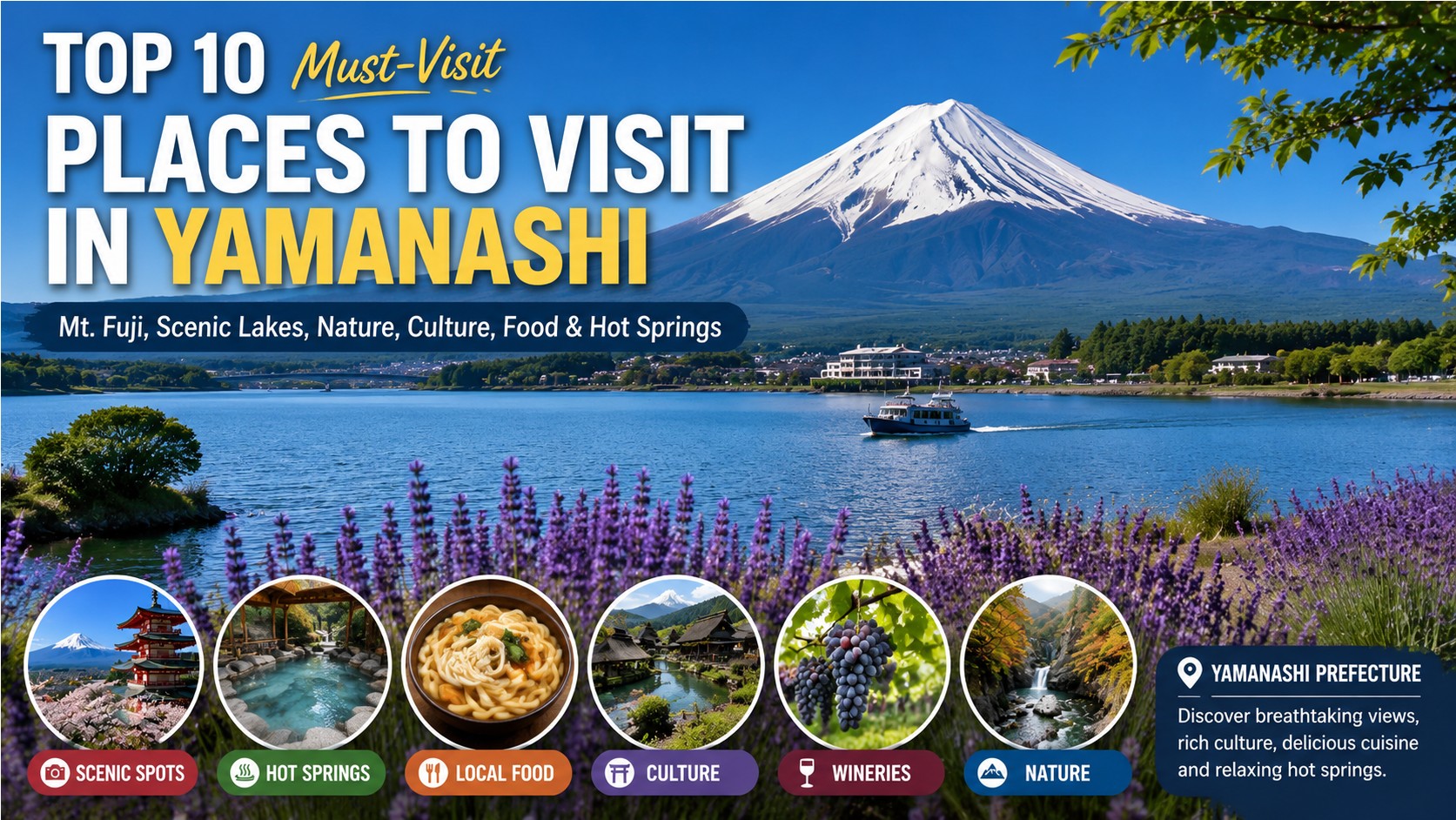
Yamanashi Prefecture is often associated with one iconic landmark—Mt. Fuji.
However, there is much more to discover beyond Japan’s highest mountain.
From peaceful lakes and historic hot spring towns to dramatic mountain valleys, wineries and seasonal fruit farms, Yamanashi offers a remarkable variety of experiences that are difficult to explore in a single trip.
It is an excellent destination both before or after climbing Mt. Fuji and as a standalone holiday filled with nature, culture and local cuisine.
This guide introduces the best places to visit in Yamanashi, estimated stay times for each attraction, seasonal highlights, local food and a suggested itinerary for first-time visitors.
- What Is Yamanashi Like?
- 1. Mt. Fuji Panoramic Ropeway
- 2. Lake Kawaguchi
- 3. Arakurayama Sengen Park
- 4. Oshino Hakkai
- 5. Shosenkyo Gorge
- 6. Takeda Shrine
- 7. Lake Yamanaka
- 8. Lake Motosu
- 9. Lake Shoji
- 10. Saiko Iyashi-no-Sato Nenba
- Enjoy Yamanashi in Every Season
- Spring | Cherry Blossoms and Peach Blossoms
- Summer | Lakes, Highlands and Seasonal Fruit
- Autumn | Colourful Leaves and Local Wine
- Winter | Snow-Capped Mt. Fuji and Hot Springs
- Seasonal Comparison Table
- Hoto Noodles
- Yoshida Udon
- Shingen Mochi
- Peaches
- Shine Muscat Grapes
- Yamanashi Wine
- Kawaguchiko Hot Springs
- Lake Yamanaka Hot Springs
- Isawa Onsen
- Before Your Climb
- After Your Climb
- Don’t Try to Visit Too Many Areas in One Day
- Visit Mt. Fuji Early in the Morning
- Choose Accommodation Carefully
What Is Yamanashi Like?
Surrounded by magnificent mountains, Yamanashi is one of the country’s most scenic regions.
Visitors can enjoy the Fuji Five Lakes, the spectacular Shosenkyo Gorge, historic sites connected with Takeda Shingen, relaxing hot springs, wineries and some of the finest seasonal fruit.
Highlights include:
- Spectacular views of Mt. Fuji and beautiful lakes
- A wide selection of hot spring resorts
- Famous peaches and grapes
- One of the country’s leading wine-producing regions
- Rich history and traditional culture
- Beautiful scenery throughout all four seasons
For first-time visitors, staying around Lake Kawaguchi makes planning much easier, as many attractions, hotels and restaurants are located nearby.
Yamanashi Sightseeing Spot Stay Time Comparison Table
The following estimates refer to the recommended amount of time to spend at each attraction after arriving, including sightseeing, walking, photography and short breaks.
Travel time between attractions is not included.
Actual stay times may vary depending on weather, crowds and the activities you choose.
| Attraction | Recommended Stay Time | Best Experience | Recommendation |
|---|---|---|---|
| Mt. Fuji Panoramic Ropeway | About 1–1.5 hours | Observatory & photography | ⭐⭐⭐⭐⭐ |
| Lake Kawaguchi | About 2–4 hours | Lakeside walk, sightseeing boat, cafés | ⭐⭐⭐⭐⭐ |
| Arakurayama Sengen Park | About 1.5–2 hours | Chureito Pagoda & Mt. Fuji views | ⭐⭐⭐⭐⭐ |
| Oshino Hakkai | About 1–2 hours | Walking around the spring ponds | ⭐⭐⭐⭐⭐ |
| Shosenkyo Gorge | About 2–5 hours | Gorge walk, waterfall & ropeway | ⭐⭐⭐⭐⭐ |
| Takeda Shrine | About 45–60 minutes | Historic shrine visit | ⭐⭐⭐⭐☆ |
| Lake Yamanaka | About 2–4 hours | Lakeside walk & cycling | ⭐⭐⭐⭐☆ |
| Lake Motosu | About 1–2 hours | Photography & quiet lakeside walk | ⭐⭐⭐⭐☆ |
| Lake Shoji | About 1–2 hours | Mt. Fuji photography & peaceful scenery | ⭐⭐⭐⭐☆ |
| Saiko Iyashi-no-Sato Nenba | About 1.5–2 hours | Traditional village & cultural experience | ⭐⭐⭐⭐⭐ |
Lake Kawaguchi and Lake Yamanaka estimates assume visitors enjoy a section of the lakeshore, a sightseeing boat or a café, rather than walking around the entire lake.
For Shosenkyo Gorge, the required time depends greatly on how much of the valley you explore. Around two hours is suitable for the main highlights, while visitors planning to walk the gorge and ride the ropeway should allow between three and five hours.
Top 10 Recommended Places to Visit in Yamanashi
1. Mt. Fuji Panoramic Ropeway

Recommendation: ⭐⭐⭐⭐⭐
The Mt. Fuji Panoramic Ropeway is one of the easiest ways to enjoy breathtaking views over Lake Kawaguchi and Mt. Fuji from above.
From the observation area near the summit, visitors can admire spectacular panoramic scenery when weather conditions are clear.
Because the attraction can be enjoyed within a relatively short time, it is an excellent choice for first-time visitors or anyone with a limited sightseeing schedule.
Please note that services may be suspended due to strong winds or severe weather. Check the official website before visiting.
Official Website:
https://www.mtfujiropeway.jp/
Google Maps
https://www.google.com/maps/search/?api=1&query=Mt.+Fuji+Panoramic+Ropeway
2. Lake Kawaguchi
Recommendation: ⭐⭐⭐⭐⭐
Lake Kawaguchi is the most popular and convenient area within the Fuji Five Lakes.
The lakeside offers a wide variety of experiences, including relaxing walks, sightseeing cruises, ropeway rides, museums, cafés and hot spring resorts.
Early mornings are particularly beautiful, as calm water occasionally reflects Mt. Fuji like a mirror.
For first-time visitors, spending one or two nights around Lake Kawaguchi provides an ideal base for exploring many of Yamanashi’s most famous attractions.
Google Maps
https://www.google.com/maps/search/?api=1&query=Lake+Kawaguchi
3. Arakurayama Sengen Park
Recommendation: ⭐⭐⭐⭐⭐
Arakurayama Sengen Park is one of the most photographed viewpoints in Yamanashi.
From the observation deck, visitors can enjoy an unforgettable view of the Chureito Pagoda standing in front of Mt. Fuji.
The scenery changes beautifully throughout the year, with cherry blossoms in spring and colourful autumn leaves creating particularly impressive landscapes.
Reaching the viewpoint requires climbing a considerable number of steps, so comfortable walking shoes are recommended.
During the cherry blossom and autumn foliage seasons, the park becomes extremely popular. Arriving early in the morning offers a quieter experience and better opportunities for photography.
Google Maps
https://www.google.com/maps/search/?api=1&query=Arakurayama+Sengen+Park
4. Oshino Hakkai
Recommendation: ⭐⭐⭐⭐⭐
Oshino Hakkai is a group of eight crystal-clear spring ponds fed by underground water from Mt. Fuji.
Its exceptionally clear water, traditional village scenery and peaceful atmosphere allow visitors to experience both the natural beauty and cultural heritage of the Mt. Fuji area.
Unlike many tourist attractions, Oshino Hakkai is not simply a sightseeing destination—it is also an important cultural site. The ponds form part of the UNESCO World Heritage property associated with Mt. Fuji and are recognised for their historical and environmental significance.
If you only explore the central area, around one hour is usually enough. Visitors wishing to walk around all eight ponds at a relaxed pace should allow approximately 1.5 to 2 hours.
Official Tourism Information:
https://www.yamanashi-kankou.jp/english/
Google Maps
https://www.google.com/maps/search/?api=1&query=Oshino+Hakkai
5. Shosenkyo Gorge
Recommendation: ⭐⭐⭐⭐⭐
Shosenkyo Gorge is widely regarded as one of the country’s most beautiful mountain valleys.
Towering granite cliffs, unusual rock formations, flowing streams and impressive waterfalls create spectacular scenery throughout the year.
Some of the best-known highlights include Kakuenpo Rock, Ishimon Gate and Senga Falls.
Well-maintained walking trails make the gorge suitable for visitors who simply want a short walk as well as those planning a longer hike.
Spring offers fresh greenery, while autumn transforms the valley into one of Yamanashi’s most popular destinations for autumn colours.
A short visit covering the main viewpoints takes around two hours. Visitors planning to walk further through the gorge and ride the ropeway should allow between three and five hours.
Official Website:
https://www.shosenkyo-kankoukyokai.com/
Google Maps
https://www.google.com/maps/search/?api=1&query=Shosenkyo+Gorge
6. Takeda Shrine
Recommendation: ⭐⭐⭐⭐☆
Takeda Shrine is dedicated to Takeda Shingen, one of the most famous military leaders of the Sengoku Period.
The shrine offers a completely different atmosphere from the Fuji Five Lakes area and provides an opportunity to experience Yamanashi’s rich history.
Visitors can comfortably explore the shrine grounds in less than one hour.
For a full day of sightseeing, many travellers combine Takeda Shrine with Shosenkyo Gorge, Kofu Castle Ruins or Isawa Onsen.
Official Website:
https://www.takedajinja.or.jp/
Google Maps
https://www.google.com/maps/search/?api=1&query=Takeda+Shrine+Yamanashi
7. Lake Yamanaka
Recommendation: ⭐⭐⭐⭐☆
Lake Yamanaka is the largest of the Fuji Five Lakes and offers wide-open scenery with magnificent views of Mt. Fuji.
Popular activities include lakeside walks, cycling, sightseeing cruises and seasonal outdoor experiences.
Compared with Lake Kawaguchi, attractions are spread over a larger area, so travelling by local bus, bicycle or taxi is often more convenient than walking.
Lake Yamanaka is an excellent choice for families looking for outdoor activities as well as couples seeking a peaceful lakeside escape.
Google Maps
https://www.google.com/maps/search/?api=1&query=Lake+Yamanaka
8. Lake Motosu
Recommendation: ⭐⭐⭐⭐☆
Lake Motosu is the deepest of the Fuji Five Lakes and is known for its peaceful natural surroundings.
One of its most famous viewpoints is the landscape that inspired the design found on Japan’s former ¥1,000 banknote.
Unlike Lake Kawaguchi, tourist facilities are limited, making Lake Motosu ideal for visitors looking for quiet scenery and photography opportunities.
If travelling by public transport, check bus timetables in advance, as services are less frequent than around Lake Kawaguchi.
Google Maps
https://www.google.com/maps/search/?api=1&query=Lake+Motosu
9. Lake Shoji
Recommendation: ⭐⭐⭐⭐☆
Lake Shoji is the smallest of the Fuji Five Lakes and is well known for its peaceful atmosphere.
It is famous for the beautiful “Kodaki Fuji” view, where Mt. Fuji appears behind Omuro Mountain, creating the impression of a smaller mountain embracing the larger peak.
Facilities around the lake are limited, making it an ideal destination for visitors who enjoy quiet walks, photography and relaxing lakeside scenery.
Many travellers visit Lake Shoji together with Lake Motosu or Lake Saiko to appreciate the unique character of each lake.
Google Maps
https://www.google.com/maps/search/?api=1&query=Lake+Shoji+Yamanashi
10. Saiko Iyashi-no-Sato Nenba
Recommendation: ⭐⭐⭐⭐⭐
Saiko Iyashi-no-Sato Nenba is a reconstructed traditional village featuring beautifully preserved thatched-roof houses.
Visitors can enjoy views of Mt. Fuji while experiencing traditional architecture, local crafts and the atmosphere of rural Japan.
It is an excellent destination for travellers interested not only in scenery but also in the history and culture of the region.
A visit typically takes around 1.5 to 2 hours, allowing enough time to explore the village, browse local craft shops and enjoy the peaceful surroundings.
Official Website:
https://saikoiyashinosatonenba.jp/
Google Maps
https://www.google.com/maps/search/?api=1&query=Saiko+Iyashi+no+Sato+Nenba
Enjoy Yamanashi in Every Season
One of Yamanashi’s greatest attractions is that the scenery changes dramatically throughout the year.
Choosing the right season can make your trip even more memorable, as each time of year offers completely different landscapes and experiences.
Spring | Cherry Blossoms and Peach Blossoms
Spring is one of the most beautiful seasons to visit Yamanashi, when snow-capped Mt. Fuji is surrounded by cherry blossoms and peach flowers.
Recommended places
- Arakurayama Sengen Park
- Northern shore of Lake Kawaguchi
- Oishi Park
- Fuefuki and Katsunuma
- Takeda Shrine
Cherry blossoms usually bloom earlier around Lake Kawaguchi than in higher elevations, while the Fuefuki Basin becomes famous for its vast peach orchards covered in soft pink flowers.
Because blooming periods vary depending on weather and elevation, checking the latest flowering information before travelling is recommended.
Popular photography spots can become very crowded, so visiting early in the morning provides a more relaxed experience.
Summer | Lakes, Highlands and Seasonal Fruit

Summer is perfect for enjoying Yamanashi’s lakes, fresh mountain air and famous fruit.
Visitors can walk along the shores of the Fuji Five Lakes, cycle beside Lake Yamanaka or enjoy sightseeing cruises while taking in magnificent views of Mt. Fuji.
Recommended places
- Lake Kawaguchi
- Lake Yamanaka
- Lake Motosu
- Oishi Park
- Shosenkyo Gorge
- Peach and grape farms
Summer is also the season for Yamanashi’s famous peaches and grapes.
Although temperatures can become quite high in the Kofu Basin, lakeside and highland areas are generally more comfortable.
Mt. Fuji is often clearer in the early morning before clouds begin to form later in the day.
Autumn | Colourful Leaves and Local Wine
Autumn transforms Yamanashi into a landscape of brilliant red, orange and gold.
Shosenkyo Gorge and Lake Kawaguchi are among the region’s most popular autumn destinations, while Katsunuma offers excellent opportunities to enjoy vineyards and local wineries.
Recommended places
- Shosenkyo Gorge
- Lake Kawaguchi
- Saiko Iyashi-no-Sato Nenba
- Lake Yamanaka
- Katsunuma wineries
Roads and car parks can become extremely busy during the peak autumn foliage season.
Rather than trying to visit several distant attractions in one day, it is usually more enjoyable to explore one area at a relaxed pace.
Winter | Snow-Capped Mt. Fuji and Hot Springs
Winter offers some of the clearest views of Mt. Fuji thanks to the crisp, dry air.
After a day of sightseeing, relaxing in a hot spring while admiring snow-covered scenery creates a memorable travel experience.
Recommended places
- Lake Kawaguchi
- Lake Yamanaka
- Arakurayama Sengen Park
- Oshino Hakkai
- Kawaguchiko Hot Springs
- Isawa Onsen
Snow and icy roads are possible in mountainous areas.
If you are unfamiliar with winter driving conditions, travelling by train, local bus, taxi or licensed private transfer is generally the safer option.
Seasonal Comparison Table
| Season | Highlights | Recommended Areas | Crowd Level | Recommendation |
|---|---|---|---|---|
| Spring | Cherry blossoms, peach blossoms and snow-capped Mt. Fuji | Lake Kawaguchi, Arakurayama, Fuefuki | Busy during blossom season | ⭐⭐⭐⭐⭐ |
| Summer | Lakes, highlands, seasonal fruit | Fuji Five Lakes, Oishi Park, Shosenkyo | Busy during holidays | ⭐⭐⭐⭐☆ |
| Autumn | Autumn foliage, grapes and wineries | Shosenkyo, Lake Kawaguchi, Katsunuma | Very busy during peak foliage | ⭐⭐⭐⭐⭐ |
| Winter | Clear Mt. Fuji views and hot springs | Lake Kawaguchi, Lake Yamanaka, Isawa Onsen | Generally quieter | ⭐⭐⭐⭐☆ |
Must-Try Local Food in Yamanashi
Hoto Noodles
Recommendation: ⭐⭐⭐⭐⭐
Hoto is Yamanashi’s signature local dish.
Thick flat noodles are slowly simmered with seasonal vegetables in a rich miso-based soup, creating a hearty and comforting meal.
Many restaurants have their own recipes, making it enjoyable to compare different styles during your trip.
Yoshida Udon
Recommendation: ⭐⭐⭐⭐☆
Yoshida Udon is famous for its exceptionally firm and chewy noodles.
Many local restaurants serve it with cabbage and, in some cases, horse meat, creating a unique regional flavour.
As some shops only open during lunchtime, checking opening hours in advance is recommended.
Shingen Mochi
Recommendation: ⭐⭐⭐⭐⭐
Shingen Mochi is one of Yamanashi’s best-known traditional sweets.
Served with roasted soybean flour and brown sugar syrup, it is also a popular souvenir.
Peaches
Recommendation: ⭐⭐⭐⭐⭐
Yamanashi is one of the country’s leading peach-producing regions.
During summer, visitors can enjoy freshly harvested peaches and even participate in fruit-picking experiences at local farms.
Harvest periods vary depending on weather and variety, so checking the latest information before visiting is advisable.
Shine Muscat Grapes
Recommendation: ⭐⭐⭐⭐⭐
Shine Muscat grapes are among Yamanashi’s most famous seasonal fruits.
From summer through autumn, many orchards and roadside markets sell freshly harvested grapes, while some farms also offer grape-picking experiences.
Yamanashi Wine
Recommendation: ⭐⭐⭐⭐⭐
Yamanashi is widely recognised as one of the country’s leading wine-producing regions.
The Katsunuma area is home to numerous wineries where visitors can tour vineyards, learn about wine production and enjoy tastings.
As tasting programmes differ between wineries, advance reservations are recommended.
If you plan to sample wine, avoid driving and instead use trains, taxis or organised transportation.
Relax in Yamanashi’s Hot Springs
A visit to Yamanashi is not complete without experiencing one of its relaxing hot spring resorts.
Kawaguchiko Hot Springs
Staying around Lake Kawaguchi allows visitors to combine sightseeing with relaxing hot spring baths.
Some accommodation offers open-air baths or guest rooms overlooking Mt. Fuji.
However, not every room provides mountain views, so it is worth checking room details before booking.
Lake Yamanaka Hot Springs
Lake Yamanaka offers a quieter atmosphere than many other resort areas.
Families may wish to choose spacious rooms or connecting rooms, while couples often enjoy accommodation with private baths.
Isawa Onsen
Isawa Onsen is an excellent base for exploring Kofu, Shosenkyo Gorge and the Katsunuma wine region.
Many ryokan also offer private baths, allowing visitors to enjoy a more peaceful hot spring experience.
Suggested 3-Day Yamanashi Itinerary
| Day | Suggested Activities | Overnight Stay |
|---|---|---|
| Day 1 | Lake Kawaguchi, Mt. Fuji Panoramic Ropeway, lakeside walk | Lake Kawaguchi |
| Day 2 | Arakurayama Sengen Park, Oshino Hakkai, Lake Yamanaka | Lake Kawaguchi or Lake Yamanaka |
| Day 3 | Shosenkyo Gorge, Takeda Shrine, Katsunuma or Isawa Onsen | Continue your journey |
Day 1
Arrive at Lake Kawaguchi, leave your luggage at your hotel and enjoy a relaxing lakeside walk.
Spend the afternoon riding the Mt. Fuji Panoramic Ropeway or taking a sightseeing cruise before unwinding at a hot spring hotel.
After a long journey, avoid packing too many activities into your first day.
Allowing time to rest helps you enjoy the remainder of your trip more comfortably.
Day 2
Visit Arakurayama Sengen Park early in the morning for spectacular views of Mt. Fuji.
Continue to Oshino Hakkai before spending the afternoon around Lake Yamanaka.
If travelling by public transport, check bus schedules in advance to avoid missing the final services.
Day 3
Travel towards Kofu to explore Shosenkyo Gorge before visiting Takeda Shrine.
If time allows, continue to Katsunuma for winery visits or finish your journey with a relaxing stay at Isawa Onsen.
Trying to include too many distant attractions in one day can make the journey feel rushed, so choosing either nature or wine experiences usually results in a more enjoyable itinerary.
Combining Yamanashi with a Mt. Fuji Climb
Yamanashi is an excellent destination before or after climbing Mt. Fuji.
Before Your Climb
- Stay around Lake Kawaguchi or Fujiyoshida.
- Check your climbing equipment.
- Confirm transportation for the following morning.
- Avoid excessive sightseeing.
- Enjoy an early dinner and get plenty of rest.
After Your Climb
- Relax in a hot spring.
- Enjoy a gentle walk beside Lake Kawaguchi.
- Try a warm bowl of Hoto noodles.
- Choose attractions that require minimal physical effort.
Avoid planning long hikes or extended driving immediately after descending Mt. Fuji.
A peaceful lakeside café or hot spring is a far more comfortable way to recover.
Practical Tips for Visiting Yamanashi
Don’t Try to Visit Too Many Areas in One Day
Although attractions may appear close on a map, travelling between them often takes longer than expected.
Planning one sightseeing area per day usually creates a much more enjoyable itinerary.
Examples include:
- Lake Kawaguchi and Lake Saiko
- Oshino Hakkai and Lake Yamanaka
- Kofu and Shosenkyo Gorge
- Katsunuma and Isawa Onsen
Visit Mt. Fuji Early in the Morning
Mt. Fuji is often clearest during the morning before clouds develop later in the day.
If mountain views are your priority, schedule observation points as early as possible.
Choose Accommodation Carefully
Comfortable accommodation can greatly improve your overall travel experience.
When booking, consider checking:
- Early check-in availability
- Luggage storage
- Spacious rooms
- Connecting rooms
- Private hot springs
- Hotel shuttle services
- Flexible cancellation policies
For families or travellers carrying large luggage, licensed private transfers between stations, airports and accommodation can make travelling much easier.
Conclusion | Discover More Than Just Mt. Fuji
Yamanashi offers far more than magnificent views of Mt. Fuji.
Peaceful lakes, dramatic mountain valleys, relaxing hot springs, rich history, seasonal fruit and excellent local cuisine all combine to create an unforgettable destination.
First-time visitors will find Lake Kawaguchi an ideal base for exploring Arakurayama Sengen Park, Oshino Hakkai and Lake Yamanaka.
Those with additional time can continue to Shosenkyo Gorge, Takeda Shrine, Katsunuma and Isawa Onsen to discover even more of the region’s character.
Whether you visit during cherry blossom season, the vibrant colours of autumn, the warmth of summer or the peaceful beauty of winter, Yamanashi offers memorable experiences throughout the year.
Rather than rushing from one attraction to another, take time to enjoy the scenery, local culture and relaxing hot springs.
Doing so will leave you with memories that last long after your journey has ended.
Travel Reminder: Opening hours, admission fees, transportation schedules and seasonal conditions may change. Always check the latest information on official websites before travelling.
コメント