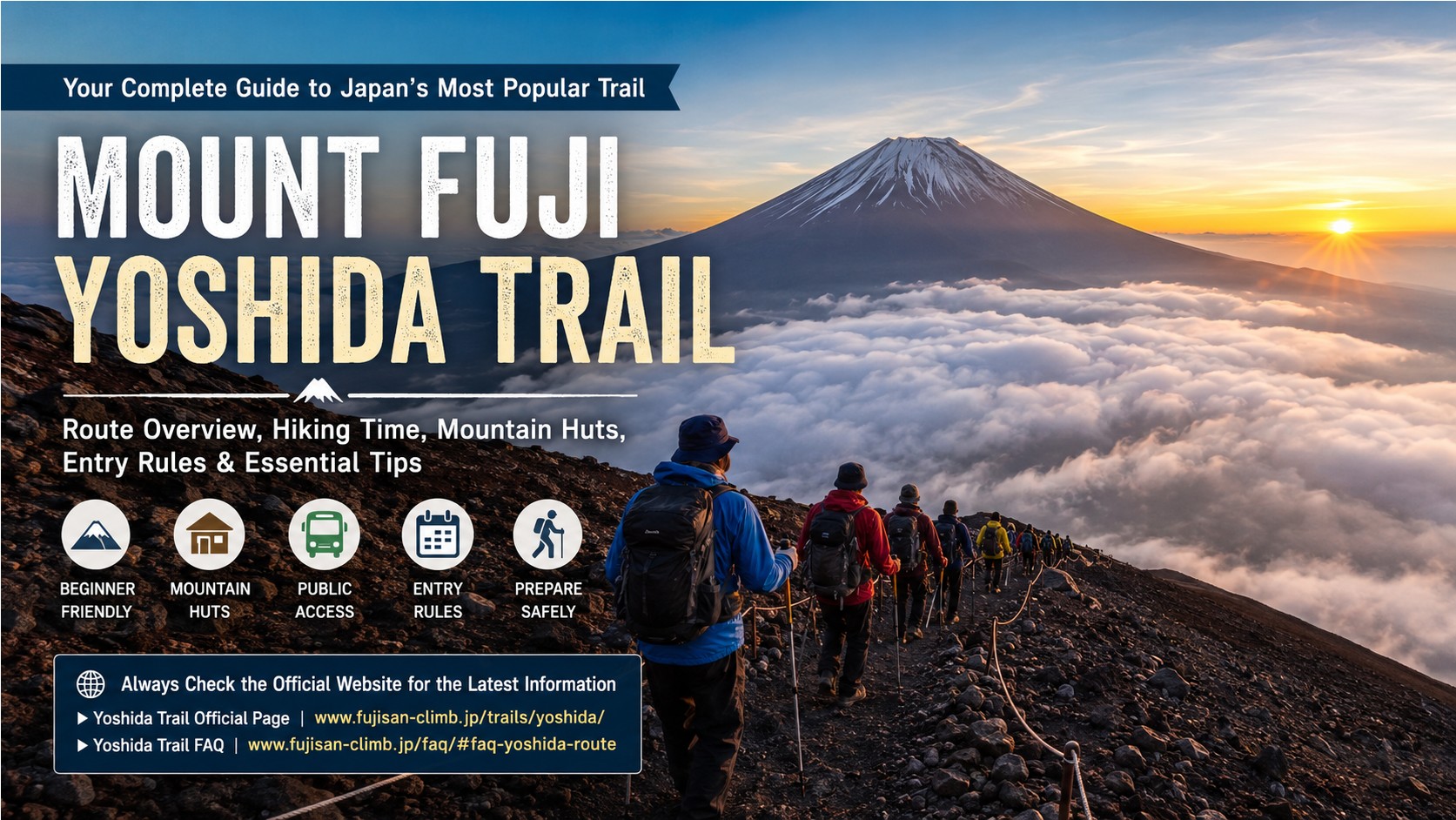

The Yoshida Trail is often the first route considered by travellers planning their first climb of Mount Fuji. 🗻
Beginning at the Fuji-Subaru Line 5th Station, the route offers more mountain huts than the other main trails and relatively convenient access to the trailhead.
For these reasons, it is frequently described as a beginner-friendly route. However, this does not mean that the climb is easy.
Above 3,000 metres, climbers may face steep rocky sections, low temperatures, strong winds, rapidly changing weather and many hours of continuous walking.
This guide explains the Yoshida Trail’s main features, difficulty, estimated hiking times, mountain huts, access, descent conditions and important rules to check before climbing.
- Most Important: Check the Official Website Before Climbing
- What Is the Yoshida Trail?
- Can Beginners Climb the Yoshida Trail?
- Why the Yoshida Trail Is Popular
- The Route from the 5th Station to the Summit
- Yoshida Trail Hiking Time
- An Overnight Mountain Hut Plan Is Recommended for Beginners
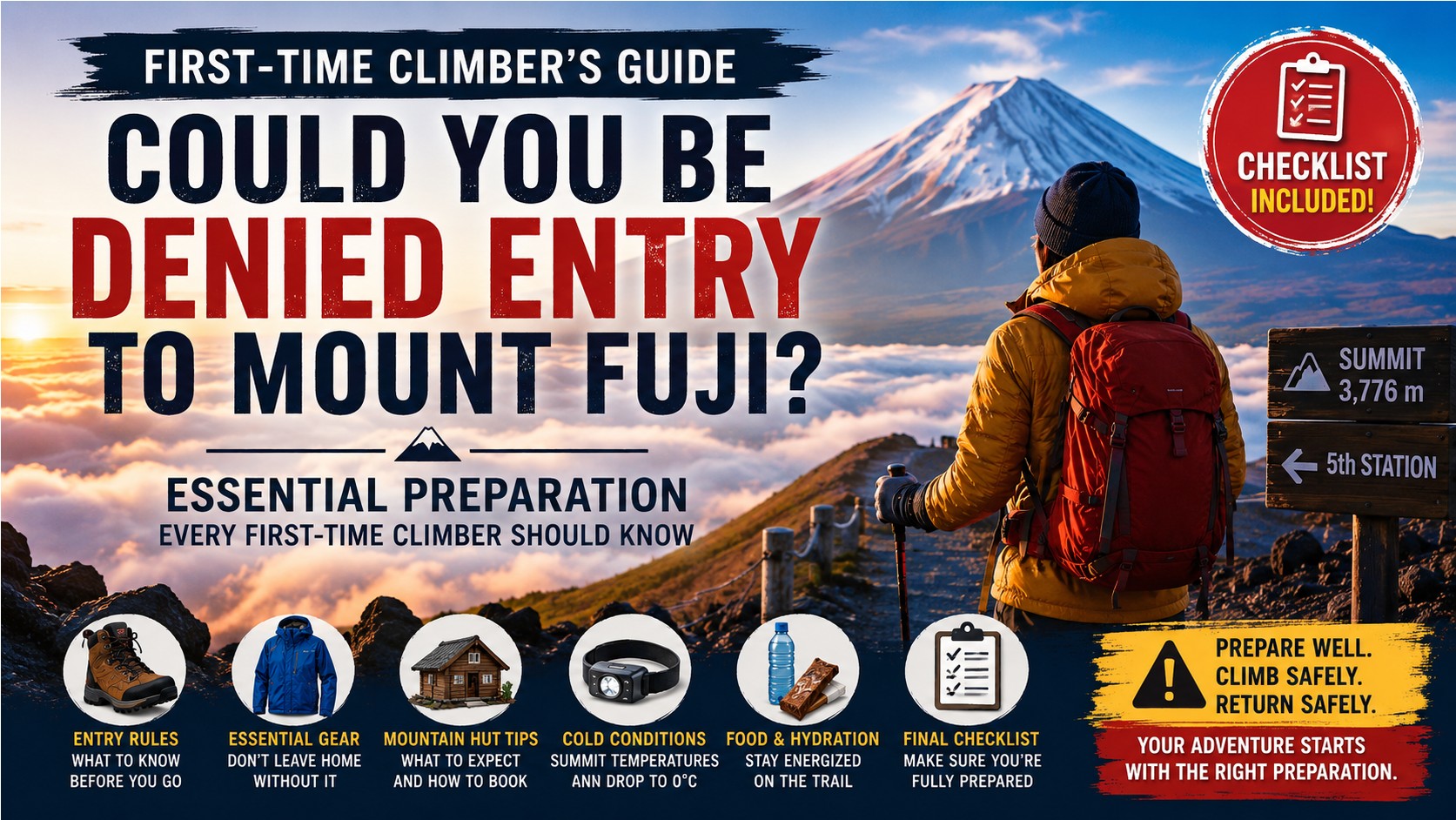
- Yoshida Trail Entry Rules and Passage Restrictions
- Always Confirm Entry Rules on the Official Website
- Avoid Overnight Bullet Climbing
- Essential Equipment for the Yoshida Trail
- What to Expect on the Descent
- How to Avoid the Busiest Crowds
- Who Should Choose the Yoshida Trail?
- Frequently Asked Questions About the Yoshida Trail
- Final Thoughts: Read the Guide, Then Check the Official Pages
Most Important: Check the Official Website Before Climbing
Mount Fuji’s opening dates, trail conditions, passage restrictions, hiking fees, gate hours, mountain hut operations, bus services and private vehicle restrictions may change.
This article is a general guide designed to help you understand the Yoshida Trail and prepare your climbing plan.
Before climbing, always check the latest information on the official Yoshida Trail page.
▶ Official Mount Fuji Climbing Website: Yoshida Trail
For questions about reservations, entry procedures, mountain huts, payments and restrictions, the official FAQ is also strongly recommended.
What Is the Yoshida Trail?
The Yoshida Trail approaches the summit from the Yamanashi side of Mount Fuji.
Most climbers begin at the Fuji-Subaru Line 5th Station, located at approximately 2,300 metres above sea level.
Yellow route signs and information boards mark the trail, and separate ascent and descent paths are used for much of the journey. 🧭
The Yoshida Trail is known for the following features:
- More mountain huts than the other main routes
- A high starting point at the Fuji-Subaru Line 5th Station
- Relatively convenient public transport access
- Separate ascent and descent paths in many sections
- Large numbers of climbers during peak periods
- A shared upper section with the Subashiri Trail above the 8th Station
Yoshida Trail Overview
| Item | Details |
|---|---|
| Main starting point | Fuji-Subaru Line 5th Station |
| Trailhead elevation | Approximately 2,300 m |
| Elevation gain to the summit | Approximately 1,450 m |
| Standard ascent time | Approximately 6 hours |
| Standard descent time | Approximately 4 hours |
| Beginner suitability | ★★★★★ |
| Mountain huts | Relatively numerous |
| Crowding | High |
| Main advantage | Convenient access and frequent mountain huts |
Walking times vary significantly depending on fitness, experience, weather, trail conditions and congestion.
First-time climbers should plan for a longer journey than the standard times shown on route maps.
Can Beginners Climb the Yoshida Trail?
The Yoshida Trail is one of the most practical choices for first-time Mount Fuji climbers.
The large number of mountain huts and relatively clear route guidance can make planning easier than on routes with fewer facilities.
However, beginner-friendly does not mean that preparation is optional.
The Yoshida Trail still presents several challenges:
- Long hours of continuous walking
- Increasingly rocky terrain from around the 7th Station
- Heavy congestion above the 8th Station
- Much lower temperatures near the summit
- Sudden changes in wind and weather
- Loose volcanic gravel during the descent
- Significant pressure on the feet and knees
Mount Fuji rises to 3,776 metres.
Although the route does not require advanced climbing techniques, the altitude, weather and duration make it a serious mountain journey.
Why the Yoshida Trail Is Popular
More Mountain Huts Along the Ascent
One of the Yoshida Trail’s greatest advantages is the number of mountain huts located along the ascent. 🛖
Depending on the facility, mountain huts may offer:
- Overnight accommodation
- Simple meals
- Drinking water for purchase
- Toilets
- Snacks and basic climbing supplies
- Temporary shelter during difficult weather
Mountain huts are very different from conventional hotels or ryokan.
Water is extremely limited, and many huts do not have running water, sinks, showers or bathing facilities. Sleeping spaces are simple and may be shared.
Opening periods, reservation dates, accommodation prices, meals and cancellation policies vary between mountain huts.
Once you have chosen a hut, check its own official website for the latest details.
Important
A mountain hut reservation and a Yoshida Trail passage reservation are separate procedures.
Reserving accommodation does not necessarily complete the required passage payment or entry process.
Check the official FAQ before finalising your reservations.
Convenient Public Transport Access
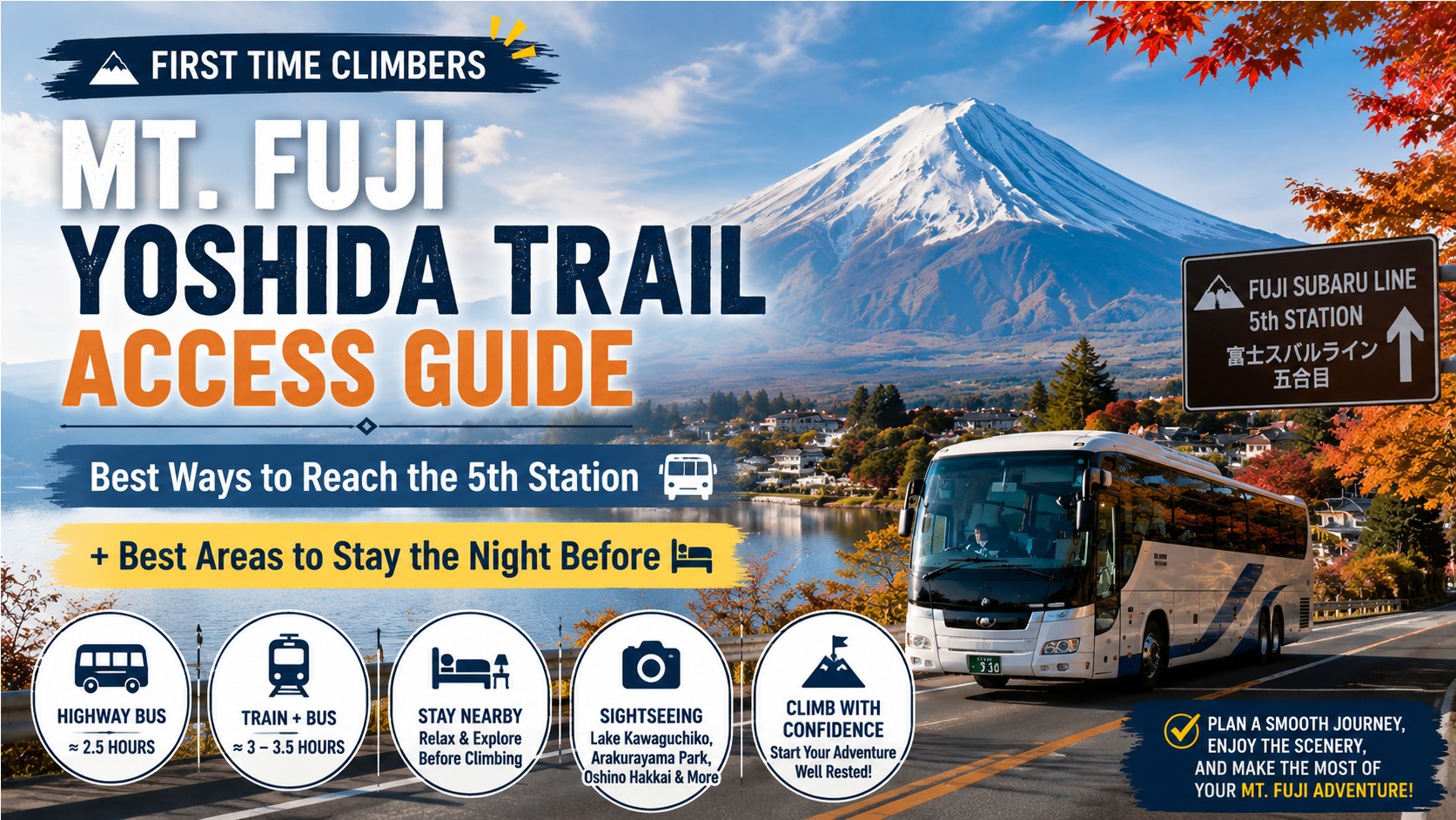
Climbing buses operate to the Fuji-Subaru Line 5th Station from locations such as Kawaguchiko Station and Mount Fuji Station. 🚌
Direct services from larger transport hubs may also operate during parts of the climbing season.
However, operating dates, schedules and reservation requirements can change each year.
Do not assume that climbing buses or shuttle buses operate throughout the night.
When planning the journey, confirm:
- The first bus to the 5th Station
- Return services after descending
- The final bus departure
- Possible waiting times during busy periods
- Transfer time from parking areas to shuttle buses
After a long journey, it may be more comfortable to stay near the mountain for one night before climbing.
A quiet arrival day, comfortable accommodation and sufficient sleep can provide better preparation than beginning the climb while already tired.
Relatively Clear Route Guidance
The Yoshida Trail is heavily used and has relatively clear route signs.
During busy hours, climbers are also unlikely to be completely alone.
However, signs can still be missed in darkness, fog or severe weather.
Extra care is required during the descent, where the Yoshida and Subashiri descent routes separate.
Always follow the yellow Yoshida Trail signs.
The Route from the 5th Station to the Summit
Fuji-Subaru Line 5th Station to the 6th Station
The first section is relatively gentle.
Do not begin walking quickly immediately after arrival. Allow time for your body to adjust to the altitude.
Before leaving the 5th Station, complete the necessary entry procedures and check:
- Clothing and equipment
- Food and drinking water
- Toilet access
- Weather conditions
- Transport plans
- Reservation documents
Spending time at the 5th Station before climbing is an important part of the itinerary.
6th Station to the 7th Station
Beyond the 6th Station, the trees gradually disappear and the landscape becomes more exposed.
The route follows zigzagging paths across volcanic gravel, with the gradient gradually becoming steeper.
Even when you still feel energetic, avoid walking too quickly. 🚶
Do not match the pace of faster climbers. Maintain a speed that allows you to breathe steadily and continue for several hours.
7th Station to the 8th Station
Rocky sections become more frequent from around the 7th Station.
In some places, climbers may need to use their hands for balance. Gloves can help protect the hands from rough volcanic rock.
Several mountain huts are located along this section, but they should not be treated as public indoor rest areas.
Unless a hut specifically permits entry, non-guests may not be able to rest inside.
Take short breaks in suitable areas without blocking the trail or hut entrances.
8th Station to the Summit
Above the 8th Station, the Yoshida and Subashiri routes join, increasing the number of climbers.
The upper trail can become especially crowded before sunrise. 🌄
Near the summit, the route becomes narrower and progress may slow considerably.
Although the remaining distance may appear short on a map, cold temperatures, fatigue, darkness and queues can make this section feel much longer.
Reaching the summit should never take priority over safety.
Turn back or stop below the summit when weather, physical condition or remaining time makes continuing unsafe.
Yoshida Trail Hiking Time
The commonly published standard times are approximately six hours for the ascent and four hours for the descent.
However, these times may not fully include long breaks, meals, toilets, entry procedures or delays caused by congestion.
Approximate Hiking Times
| Section | Approximate time |
| 5th Station to 7th Station | Approximately 2–3 hours |
| 7th Station to 8th Station | Approximately 2–3 hours |
| 8th Station to the summit | Approximately 2–3 hours |
| Summit to 5th Station | Approximately 4–5 hours |
| Total journey including breaks | Approximately 12–15 hours or more |
First-time climbers should consider that the ascent alone may take 7–9 hours. ⏱️
Before sunrise, congestion near the summit may make the journey considerably slower than expected.
These walking times are only estimates.
Before climbing, check the latest trail conditions, restrictions, weather notices and congestion information on the official Yoshida Trail page.
▶ Official Mount Fuji Climbing Website: Yoshida Trail
The official FAQ also answers common questions about hiking times, access and entry procedures.
An Overnight Mountain Hut Plan Is Recommended for Beginners
For first-time climbers, dividing the ascent over two days is usually more manageable than attempting the entire journey without an overnight rest. 🌙
Benefits of Staying in a Mountain Hut
- The ascent is divided between two days
- Time is available to rest during the night
- Shelter is available if conditions worsen
- The itinerary can include more flexibility
- Sunrise plans are easier to organise
- The physical strain is spread across a longer period
Even with an overnight stay, complete sleep is not guaranteed.
The altitude, shared sleeping arrangements and simple facilities mean that the experience will not resemble a conventional hotel stay.
Sample One-Night Itinerary for Beginners
Day 1
10:30–11:00
Arrive at the Fuji-Subaru Line 5th Station.
11:00–12:00
Eat, use the toilet, check equipment, complete entry procedures and allow time to adjust to the altitude.
Around 12:00
Begin climbing slowly.
15:30–17:00
Reach the reserved mountain hut around the 7th or 8th Station.
Evening
Eat, organise equipment and rest.
Day 2
Departure time depends on the location of the hut, sunrise time, weather and congestion.
It is not necessary to watch the sunrise from the summit.
A quieter option is to watch the sunrise near the hut and continue towards the summit after daylight, when the busiest queues may have eased.
Leave enough time to descend and reach the 5th Station before the final transport service.
Yoshida Trail Entry Rules and Passage Restrictions
A gate is installed at the Yoshida Trail entrance near the 5th Station to manage congestion and discourage overnight climbing without accommodation. ⚠️
Depending on the climbing season, the rules may include:
- A required passage fee
- A daily climber limit
- Gate closure during certain hours
- Exceptions for confirmed mountain hut guests
- Separate passage and accommodation reservations
- Equipment checks or safety requirements
Specific fees, limits, dates, hours and reservation methods may change.
Always Confirm Entry Rules on the Official Website
Do not rely only on information published in this article.
Check the official website when making reservations and check it again immediately before climbing.
Passage Reservations and Mountain Hut Reservations Are Separate
One of the most common sources of confusion is the difference between a trail passage reservation and a mountain hut reservation.
A confirmed mountain hut booking does not automatically mean that every passage requirement has been completed.
Similarly, a passage reservation does not secure overnight accommodation.
After making reservations, confirm:
- Passage reservation completion
- Payment confirmation
- Mountain hut booking confirmation
- Hut check-in time
- Cancellation and date-change conditions
- Reservation details that can be displayed without internet access
Save screenshots or printed copies of important booking information in case mobile reception is unavailable.
Avoid Overnight Bullet Climbing
Overnight bullet climbing generally means beginning late, walking through the night without staying in a mountain hut and attempting to reach the summit for sunrise.
This approach may appear efficient, but it increases several risks:
- Sleep deprivation
- Reduced concentration and judgement
- Falls in darkness
- Severe fatigue
- Exposure to cold temperatures and strong winds
- Congestion near the summit
- Missing return transport after descending
A safe climb includes enough time not only to reach the summit, but also to descend safely.
Build the possibility of turning back into the original plan.
Essential Equipment for the Yoshida Trail
Even during the summer climbing season, the environment near the summit can be dramatically different from conditions at the 5th Station. 🎒
Strong winds can make the temperature feel much lower, even when the weather appears clear.
Essential Clothing and Equipment
- Waterproof hiking boots
- Waterproof jacket
- Waterproof trousers
- Warm insulating layers
- Gloves
- Warm hat
- Headlamp
- Spare batteries
- Drinking water
- High-energy snacks
- Route map
- Portable battery
- Small first-aid kit
- Cash and coins
- Rubbish bags
A thin rain poncho alone may not provide sufficient protection.
Strong winds can lift it, and the lower body may remain exposed to rain.
A waterproof hiking jacket and waterproof trousers are more suitable.
Carry Cash and Coins
Do not assume that ATMs or card payments will always be available.
Toilets on the mountain may request a small maintenance contribution, and change may not be available.
Carry several ¥100 coins as well as enough cash for food, drinks and unexpected expenses.
What to Expect on the Descent
The Yoshida descent route includes a long zigzagging path covered with loose volcanic gravel.
The repeated landscape and unstable surface can make the descent feel longer than the ascent.
Common difficulties include:
- Feet sliding forward inside hiking boots
- Dust entering the eyes and mouth
- Repeated pressure on the knees
- Increased risk of falling when tired
- Missing route junctions
- Running low on drinking water
There are fewer mountain huts and shops on the descent route than on the ascent.
Before leaving the summit or beginning the descent, confirm:
- Remaining water
- Toilet locations
- Weather conditions
- Remaining daylight
- Return transport times
Trekking poles may reduce pressure on the knees, but use them carefully in crowded areas and on rocky sections.
How to Avoid the Busiest Crowds
The Yoshida Trail becomes especially busy during peak climbing periods.
Congestion often occurs in the following areas:
- Rocky sections between the 7th and 8th Stations
- The section where the Yoshida and Subashiri routes merge
- The final approach before sunrise
- Toilets
- Bus stops at the 5th Station
Where possible, consider the following strategies:
- Climb on a weekday
- Avoid the busiest holiday periods
- Do not insist on watching sunrise from the summit
- Watch sunrise from near the mountain hut
- Continue to the summit after sunrise
- Arrive at the 5th Station early
- Avoid planning around the final return bus
Changing the timing by only a few hours can create a much calmer experience. ✨
Who Should Choose the Yoshida Trail?
The Yoshida Trail may be suitable for climbers who:
- Are climbing Mount Fuji for the first time
- Want to stay in a mountain hut
- Prefer to use public transport
- Feel more comfortable with frequent route markers
- Want more opportunities to purchase food and drinks
- Prefer facilities, even when the route is crowded ✅
Climbers who prioritise quiet surroundings may prefer to compare the other main routes.
However, every route reaches high altitude and requires proper preparation.
Do not choose a route based only on distance. Compare access, elevation gain, mountain huts, congestion and descent conditions.
Frequently Asked Questions About the Yoshida Trail
Can I Climb Without Reserving a Mountain Hut?
In some circumstances, climbers may be allowed to proceed without a mountain hut reservation during permitted entry hours and within the daily limit.
However, climbers without accommodation may be unable to enter during restricted hours or after the daily limit has been reached.
Always confirm the current conditions on the official FAQ page.
Does a Passage Reservation Allow Entry at Any Time?
Not necessarily.
A passage reservation may not provide an exemption from gate closure hours.
Do not assume that completing an online passage reservation allows unrestricted entry.
Can Non-Guests Rest Inside Mountain Huts?
Mountain huts are not public indoor rest areas.
Unless a hut specifically allows entry, non-guests may not be permitted to rest inside.
When resting outdoors, do not block the trail or hut entrances.
Can I Buy Food and Water During the Climb?
Food, bottled water and other drinks may be available from mountain huts along the ascent.
However, shops may close at night, supplies may sell out and facilities may not accept every payment method.
Carry enough food and water to avoid depending entirely on mountain huts.
Can Children Climb the Yoshida Trail?
This depends on the child’s fitness, hiking experience and ability to cope with cold weather, long walking hours and high altitude.
Before attempting Mount Fuji, children should have experience with long walks and lower mountain trails.
The presence of mountain huts does not remove the risks associated with high-altitude climbing.
Final Thoughts: Read the Guide, Then Check the Official Pages
The Yoshida Trail is a practical choice for many first-time Mount Fuji climbers because of its mountain huts, convenient access and clear route guidance.
However, Mount Fuji remains a 3,776-metre mountain.
Proper clothing, physical preparation, accommodation reservations, transport planning and a flexible schedule are essential.
The following information may change:
- Official opening dates
- Passage fees
- Reservation procedures
- Daily climber limits
- Gate opening and closure hours
- Trail conditions
- Mountain hut operations
- Bus schedules
- Private vehicle restrictions
- Weather and volcanic information
After using this guide to understand the route, check the official website when booking and check it again immediately before departure.
▶ Official Mount Fuji Climbing Website: Yoshida Trail
For questions about reservations, payments, accommodation, cancellations, children, facilities and restrictions, this official page is also recommended:
Reaching the summit is not the only measure of a successful climb.
The glow above the clouds, the quiet evening at a mountain hut and the slowly changing landscape can become equally memorable parts of the journey.
Plan the climb so that safety, enjoyment and the return to the trailhead are all part of the same goal.
コメント